Inside the Open Office
Date
Services
Exploratory Research, Spatial Prototyping
N
N12
Inside the Open Office
An inquiry into open-plan life
In France, 40% of employees work in open-plan offices. The model promises collaboration, flexibility, connection. But on the ground, people wear headphones. They message the colleague sitting two metres away and they stay late to make up for time lost during the day.
This project stems from a common observation: a gap is present between what the open office is designed to produce and what people actually experience inside it. We set out to understand and explore what that gap is made of.
The research
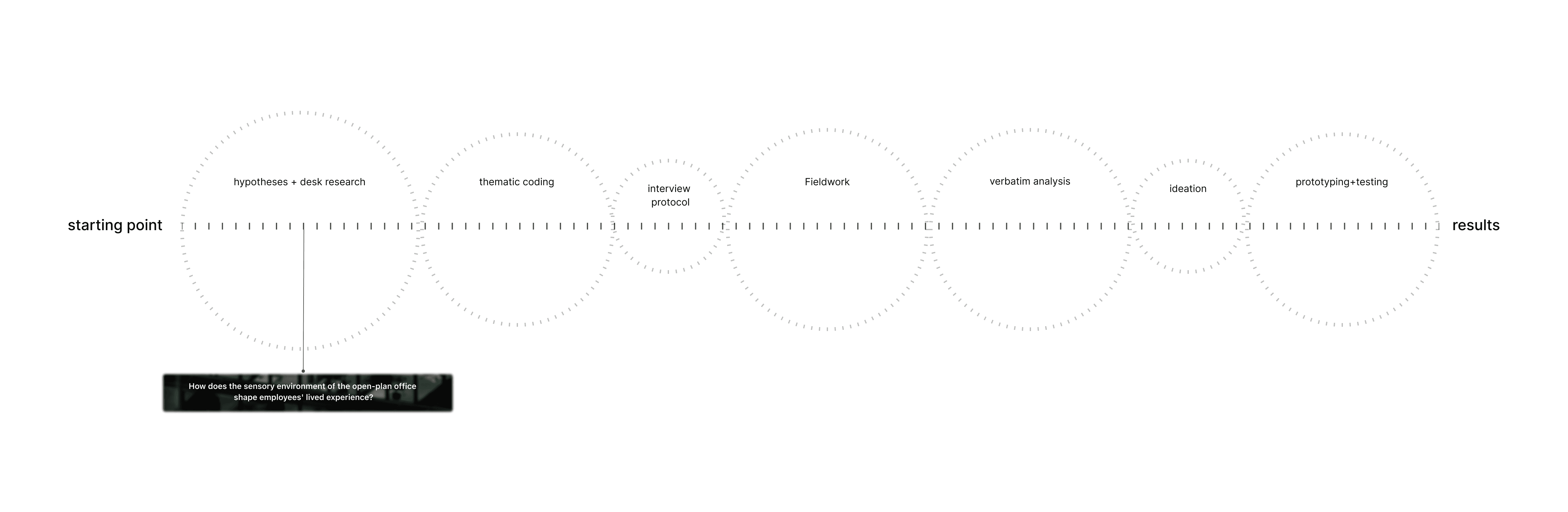
Fifteen sources were reviewed and cross-referenced. Scientific articles, systematic reviews, conference proceedings, recent publications. A methodical sorting process to map what research already knows, and where the blind spots are.
A few findings stood out.
A large-scale Australian satisfaction study found that employees in one-to-two-person offices consistently reported higher satisfaction than those in open-plan settings, and that the open spaces with the highest satisfaction scores were those with the lowest noise levels.
Bernstein & Turban's Harvard study (2018) measured that transitioning to open-plan reduced face-to-face exchanges by approximately 70%, with a corresponding rise in digital messaging.
A 2017 systematic review on office design and health identified recurring patterns across studies: cognitive fatigue, stress, and a sense of depersonalisation linked to open layouts.
Abirami's 2024 review, tracing the model's evolution from Frank Lloyd Wright's collaborative offices to today's flexible spaces, concluded:
"The ideal workspace design is not a monolithic structure, but a flexible and adaptable symphony that balances collaboration with employee well-being." — Abirami, 2024
I organised a workshop with four other designers to cross-reference these sources. Six themes emerged: trust, noise, physical comfort, social interactions, health, usage rules. A central tension emerged: the need for quiet opposes the need for connection.
The voices
Seven semi-structured interviews were conducted, alongside four auto-ethnographies. Our interview protocol was structured around four themes: daily life, physical well-being, mental well-being, social interactions. Data consisted of interview verbatims, which were analyzed using a thematic analysis approach.
"The person across from me taps their fingers on the desk, creating a repetitive noise I can hear clearly."
"My headphones start hurting after a whil, I can't stand them anymore, but I can't work without background music either."
"Loss of trust toward my colleagues and a feeling of being watched, disrupts my concentration."
"It came as a distraction during a bit of a low moment. There'd been a stressful meeting, and it helped to laugh a little and decompress."
What came through across the interviews and auto-ethnographies was that noise disturbance is less about volume than about unpredictability. Employees described a constant negotiation with their environment. The headphones appeared in nearly every account, not as a preference but as a coping strategy.
Interestingly, 33% of interviewees noted that communication in their open space happened primarily through messaging tools, despite colleagues being physically present. AA pattern that directly echoes the Harvard findings.
The proposal
The methodology combined several UX design tools to support the exploration and formalization of design solutions:
An impact/effort matrix to sort and prioritise leads.
A Crazy 6 workshop to sketch six individual visions of the ideal open office.
A 3D prototype: 1,000 m², four zones (collaboration, concentration, silence, relaxation).
The architectural reference is the Roman domus: centrality, fluid circulation between spaces with distinct functions.
We then tested the mockup through an immersive 3D walkthrough, using a Wizard of Oz protocol. Testers navigated freely, verbalising what they saw and felt.
The gap
The literature largely treats noise as a measurable variable — decibels, reverberation time, exposure levels. But the interviews pointed to something different. What employees described was a loss of control over their sensory environment. The distinction matters: it suggests that spatial design for open offices cannot rely on acoustic metrics alone, but needs to account for how people perceive, interpret and negotiate their surroundings on a moment-to-moment basis.
This raises a broader question for design. Open-plan layouts are typically conceived around functional categories. But the data suggests that the experience of space is not primarily functional. It is sensory, emotional, and deeply individual. Two people sitting at the same desk, in the same acoustic conditions, can have radically different experiences, because what matters is not the environment as measured, but the environment as felt. It is a dimension that most open-plan design practices still treat as secondary.
To note : Seven semi-structured interviews were conducted across varied profiles — different industries, levels of seniority, and open-plan configurations. The six analytical themes (trust, noise, physical comfort, social interactions, health, usage rules) were drawn from the reviewed literature, then consolidated during a workshop with six designers. The sample remains limited and the findings are situated: different profiles or organisational contexts may have surfaced different themes.
File can be sent upon request.
Team of 6 designers · Secondary research lead · Interview conduct · Qualitative analysis · 2025
